भारत   में  स्टार्टअप रेजिस्ट्रशन कराने की प्रिक्रिया निम्न है (How to Get Startup Recognition in India)

१. स्टार्टअप इंडिया की वेबसाइट पर जाएँ और नया यूजर बनायें

२.  स्टार्टअप सन्दर्भ में निम्लिखित जानकारी प्रेषित करे

  1. Name of the Startup – …………………………………
  2. Date of incorporation/ registration of Startup – …………………………………
  3. Incorporation No./ registration No. …………………………………
  4. Address and business location- …………………………………
  5. Nature of business …………………………………
  6. Contact details of Startup (Phone No. and Email)- …………………………………
  7. Permanent Account No. …………………………………
  8. Existing/ proposed activities – …………………………………

upload copy of Memorandum of Association, LLP/partnership Deed, Board Resolution etc.

स्टार्टअप मान्यता हेतु पात्रता मानदंड:

  1. स्टार्टअप को प्राइवेट लिमिटेड कंपनी के रूप में संस्थापित होना चाहिए या पार्टनरशिप फर्म या लिमिटेड लायबिलिटी के रूप में रजिस्टर्ड होना चाहिए ​
  2. पिछले किसी भी वित्तीय वर्ष में रु. 100 करोड़ से कम का कारोबार होना चाहिए
  3. किसी भी संस्था के निगमन की तिथि से अगले 10 वर्षों तक उसे स्टार्ट-अप माना जाएगा
  4. स्टार्टअप को मौजूदा प्रोडक्ट, सर्विसेज़ और प्रोसेस के इनोवेशन/सुधार की दिशा में काम करना चाहिए और रोजगार/धन उत्पन्न करने की क्षमता होनी चाहिए. एक मौजूदा संस्था के विभाजन या पहले से ही निर्मित व्यवसाय के पुनर्निर्माण को “स्टार्ट-अप” नहीं कहा जा सकता है

अधिक जानकारी के लिए, कृपया नोटिफिकेशन देखें

https://www.startupindia.gov.in/content/dam/invest-india/Templates/public/198117.pdf

Download (PDF, 198KB)


झाँसी के स्टार्टअप्स का सम्मान 

जिला उद्योग एवं उद्यम प्रोत्साहन केंद्र द्वारा आयोजित उद्यम समागम 2019 के समापन समारोह में जिला उद्योग केंद्र द्वारा झाँसी के 16 स्टार्टअप  2 स्टार्टअप मेंटर्स व बौद्धिक सम्पदा सुविधाप्रदाता को सम्मान दिया गया| 
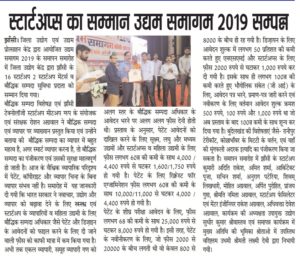
बौद्धिक सम्पदा विशेषज्ञ एवं झाँसी टेक्नोलॉजी स्टार्टअप मीटअप ग्रुप के संयोजक एवं संरक्षक ने बौद्धिक सम्पदा एवं व्यापार पर व्याख्यान प्रस्तुत किया एवं उन्होंने बताया की  बौद्धिक सम्पदा का व्यापार में बहुत महत्व है, अगर स्मार्ट व्यापार करना है, तो बौद्धिक सम्पदा का पंजीकरण एवं उसकी सुरक्षा महत्वपूर्ण हो जाती है| आज के वैश्विक व्यापारिक परिदृश्य में पेटेंट, कॉपीराइट और व्यापार चिन्ह के बिना व्यापार संभव नहीं है| समारोह में  यह जानकारी दी गयी कि भारत सरकार ने नवाचार, उद्योग और व्यापार को बढ़ावा देने के लिए MSME एवं स्टार्टअप के व्यापारियों व महिला उद्यमी के लिए बौद्धिक सम्पदा अधिकार जैसे पेटेंट और डिज़ाइन के आवेदनों को फाइल करने के लिए दी जाने वाली फ़ीस को काफी मात्रा में कम किया गया है| अभी तक एकल व्यापारी, समूह व्यापारी गण को अलग स्तर के बौद्धिक सम्पदा अधिकार के आवेदन भरने पर अलग अलग फ़ीस देनी होती थी| प्रस्ताव के अनुसार, पेटेंट आवेदनों को दाखिल करने के लिए सूक्ष्म, लघु और मध्यम उद्यमों (MSME) और स्टार्टअप्स व महिला उद्यमी के लिए फ़ीस लगभग 60% की कमी के साथ 4,000 / 4,400 रुपये से घटकर 1,600 / 1,750 रुपये हो गयी है| पेटेंट के लिए रिक्वेस्ट फॉर एग्जामिनेशन फ़ीस लगभग 60% की कमी के साथ 10,000 / 11,000 से घटकर 4,000 / 4,400 रुपये हो गयी है|

पेटेंट के शीघ्र परीक्षा (EXPEDITED EXAMINATION ) आवेदन के लिए, फ़ीस लगभग 68% की कमी के साथ 25,000 रुपये से घटकर 8,000 रुपये हो गयी है| इसी तरह, पेटेंट के नवीनीकरण के लिए, जो फ़ीस 2000 से 20000 के बीच लगती थी वो केवल 800 से 8000 के बीच ही रह गयी है|। डिज़ायन के लिए आवेदन शुल्क में लगभग 50% की कमी करते हुए एमएसएमई और स्टार्टअप्स के लिए फ़ीस 2000 रुपये से घटाकर 1,000 रुपये कर दी गयी है।

इसके साथ ही लगभग 100% की कमी करते हुए भौगोलिक संकेत (जी आई) के लिए, आवेदन पत्र भरने, प्रमाण-पत्र जारी करने एवं नवीकरण के लिए वर्तमान आवेदन शुल्क क्रमश 500 रुपये, 100 रुपये और 1,000 रुपये था जो अब प्रस्ताव के बाद 100% कमी के साथ शून्य कर दिया गया है।

बुंदेलखंड की विशेषताएं जैसे- रानीपुर टेरीकॉट, कोछाभाँवर के मिटटी के वर्तन, एवं यहाँ की मूंगफली अदरक इत्यादि का GI पंजीकरण किया जा सकता है| समापन समारोह में झाँसी के स्टार्टअप कुमारी अदिति राकेश, श्री अमित शर्मा (सांता ग्रीन वेजिटेबल), श्री सचिन शर्मा (नीलाक्ष सॉफ्ट), श्री अनुराग पटेरिया (सीस्कोर), श्री शिवम् लिखधारी (वसुधा अमृत LLP), श्री मोहित अग्रवाल (ट्रू वैल्यू कांसेप्ट), श्री अर्पित पुरोहित (तात्या मिल्क), श्री प्रांजय गुप्ता (ECO ट्री), श्रीमति नमिता अग्रवाल (राम नाथ एंड संस), स्टार्टअप फेसिलेटर एवं मेंटर इंजीनियर श्री राकेश अग्रवाल, अधिवक्ता देवेश अग्रवाल, कार्यक्रम की अध्यक्षता उपायुक्त उद्योग श्री सुधीर कुमार श्रीवास्तव एवं कार्यक्रम में मुख्य अतिथि की भूमिका श्रोताओ में उपस्तिथ वरिष्टतम उधमी श्रीमती लक्ष्मी देवी (proprietor लक्ष्मी ट्रेडर्स)  द्वारा निभायी गयी|

भारत सरकार का बड़ा फैसला अब MSME एवं स्टार्टअप के व्यापारियों के लिए पेटेंट और डिज़ाइन के आवेदनों को फाइल करने की फ़ीस में कमी

भारत सरकार ने नवाचार, उद्योग और व्यापार को बढ़ावा देने के लिए MSME एवं स्टार्टअप के व्यापारियों के लिए बौद्धिक सम्पदा अधिकार जैसे पेटेंट और डिज़ाइन के आवेदनों को फाइल करने के लिए दी जाने वाली फ़ीस को काफी मात्रा में कम करने का प्रस्ताव रखा है| अभी तक एकल व्यापारी, समूह व्यापारी गण को अलग स्तर के बौद्धिक सम्पदा अधिकार के आवेदन भरने पर अलग अलग फ़ीस देनी होती थी| 

प्रस्ताव के अनुसार, पेटेंट आवेदनों को दाखिल करने के लिए सूक्ष्म, लघु और मध्यम उद्यमों (MSME) और स्टार्टअप्स के लिए फ़ीस लगभग 60% की कमी के साथ 4,000 / 4,400 रुपये से घटकर 1,600 / 1,750 रुपये हो जाएगी।

पेटेंट के लिए रिक्वेस्ट फॉर एग्जामिनेशन फ़ीस लगभग 60% की कमी के साथ 10,000 / 11,000 से घटकर 4,000 / 4,400 रुपये हो जायेगी|

पेटेंट के शीघ्र परीक्षा (EXPEDITED EXAMINATION ) आवेदन के लिए, फ़ीस लगभग 68% की कमी के साथ 25,000 रुपये से घटकर 8,000 रुपये हो जाएगा। इसी तरह, पेटेंट के नवीनीकरण के लिए, जो फ़ीस 2000 से 20000 के बीच लगती थी वो केवल 800 से 8000 के बीच ही रह जाएगी।

मंत्रालय ने कहा कि डिज़ायन के लिए आवेदन शुल्क में लगभग 50% की कमी करते हुए एमएसएमई और स्टार्टअप्स के लिए फ़ीस 2000 रुपये से घटाकर 1,000 रुपये कर दी जाएगी।

इसके साथ ही लगभग 100% की कमी करते हुए भौगोलिक संकेत (जी आई) के लिए, आवेदन पत्र भरने, प्रमाण-पत्र जारी करने एवं नवीकरण के लिए वर्तमान आवेदन शुल्क क्रमश 500 रुपये, 100 रुपये और 1,000 रुपये था जो अब प्रस्ताव के बाद 100% कमी के साथ शून्य कर दिया जायेगा।

2016 में सरकार द्वारा अपनाई गई राष्ट्रीय आईपीआर नीति ने देश में आईपीआर शासन को और मजबूत करने का मार्ग प्रशस्त किया। पिछले 5 वर्षों में लिए गए ठोस कदमों से आईपी फाइलिंग में वृद्धि देखी गयी है 

2013-2014 से 2018-2019 के बीच में लगभग 18 प्रतिशत पेटेंट्स में और 69 प्रतिशत व्यापार चिन्ह के आवेदनों में इज़ाफा हुआ है|

पेटेंट के लिए घरेलू आवेदन संख्या 2013-14 में 22% से बढ़कर 2018-19 में लगभग  34% हो गई है। सरकार द्वारा स्कूलों, कॉलेजों, विश्वविद्यालयों, R & D संस्थानों और उद्योग समूहों में बौद्धिक  सम्पदा के लिए जागरूकता कार्यक्रम चलाए जा रहे हैं।

Download (PDF, 187KB)

Data Analytics Service

Data Analytics Services provides Buyers the capability to analyse large volume of business data, transform the data into intelligence and insight, and deliver this intelligence and insight to their business processes and business users. Such a comprehensive Data Analytics Module allows the Buyer to customize notification of certain indicators that the Buyer is interested in to trigger activities/ actions.

The Buyer is seeking the capability to analyse large volume   of business data, transform the data into intelligence and insight, and deliver this intelligence and insight to the Buyers business processes and business users. Such a comprehensive  Data Analytics Module (hereinafter referred to as DAM) should allow the Buyer to customize notification of certain indicators that the Buyer is interested in to trigger activities/actions.
The buyers also expect the Service Providers to extract the data from all the local as well as geographically distributed data sources where it may be in different formats  transform it and prepare it for analytics, reporting, data mining and visualization. It should have provision for ad-hoc queries, self service analytics including slicing, dicing and drill down capabilities on different dimensions. The Service Providers are expected to build analytics framework composed of libraries, utilities, tools, distributed file systems for storing big data sets,  splitting them on commodity machines configured in cluster for parallel processing, high availability and reliability.

The analytics framework should allow the Buyers to create run time environment in both open source (R, Python, etc.)  and proprietary technologies for reporting, real time stream analysis, machine learning, image processing, web crawling, text processing, etc.  The analytics framework can be deployed in a traditional on-premise datacenter as well as in the cloud for ad-hoc queries pertaining to the module for quick access to real time information and allow users to put in parameter to view the data from different perspectives.

This system must  help to increase efficiency,  productivity and efficacy by providing  intelligent insights into the data to different types of stakeholders Data Analytics Services (DAS)

The Service Provider needs to provide a Big Data Analytics platform, exposing Business Intelligence and analytics as a service which delivers following functionalities to the buyers:
Performing Search
Preparation of various Dashboard analytics to identify different type of hotspots
Provision to enrich the central Data repository and expose the data securely to various stakeholders.
Generation of various types of statistical reports.
Broad Scope of Work

Activities

Deliverables

Central Big-Data Repository 1. Building the required clusters with the security components.
2. Ensuring the external connectivity and test data ingestion into the system
3. Ingestion of Data sets if required
4. Incremental data ingestion automation from the instances to the Cluster
5. Entity recognition of the data being ingested from the content
Repository Security 1. Authenticate and secure clusters
2. End to End Log Analysis of the access logs of the applications
3. User Management restricting the external user registrations
Self-Serviceable BI 1. Self-serviceable BI solution for the power users to create new reports, dashboards and to expose the dashboard.
2. User Authentication
3. Exporting dashboard as PDF
4. Drill down dashboard
5. Search empowering analytics
6. Geo spatial analysis
7. Export reports
8. Interoperable dashboard analysis
Implementation 1. Data ingestion
2. Incremental data automation on Time Stamp or Auto Increment fields
3. Data standardization
4. Master data resolution
5. Cleaning of data for regeneration of missing or wrong values.
6. Record flagging
7. Geo location integration if required
8. Acts and section cleansing and standardization
9. Hive reports designing
10.API exposing to other stakeholders facilitating the Interoperability

Detailed Activities

Activities Details
Data ingestion scope 1. Providing a facility to push the messages and listening the events facilitating a real-time data analytics solution.
2. Providing the flexibility of consuming the data through API
Data Cleansing and Standardization 1. Data ingested into the system should be de-normalized by resolving the entities by a Big-data Solution
2. Data shall be cleansed followed by the de-duplication
3. Missing fields/patterns inside the data shall be re-generated/ re-calculated followed by the identification of bad records
4. All intermediate data shall be archived and a separate archival repository shall be maintained
5. Notifications/alerts shall be sent with all rules of data quality issues viz. bad records
6. Geo-Location Integration7. Transliteration API Integration. API should be provided by the department.
Data warehouse 1. A complete data warehouse shall be maintained for the ingested and cleansed data
2. The data warehouse shall be defined with the optimal file-formats and shall be followed by indexing and dynamic partitioning
3. Set of reports shall be derived from the warehouse
4. Making the reports accessible to the authorized users on demand
5. Data high availability and regular data backup maintenance shall be maintained.
High performance data discovery on large data-sets, Designing data matching algorithms across various pillars 1. Designing of the search over the complete data providing a provision to expose the datasets through a full-text search API for other stakeholders.
1. Identifying the searchable fields
2. Identifying the aggregate fields
3. Designing the solution for the data search and dynamic aggregations
4. Designing the search for various miss-spelled records
5. Designing of the Views
6. Integrating the application and the solution
7. Highlighting the searched Results matching with the search     parameters
8. Sorting the search results by the relevance and other attributes, as decided by the department
9. Fine tuning of the results
10.Testing the application
11.Deploying the solution
2. Search shall be dynamically populating the filters facilitating the end user to choose the potential fields
Data Analysis –  Visualization & Reporting 1. Analysis on the datasets
2. Identifying the possible reports
3. Designing the visualizations over the required
4. Designing the interactive dashboard
5. Authenticating the dashboard
6. Solution should be a Self-Serviceable BI with role-based authentication
7. Designed solution shall be able to schedule the reports and send alerts/notifications
8. Provided solution should have the drilldown capability to the record level during the analysis
9. Exporting of Dashboard as PDF
10.Search empowering analytics
11.Geospatial Analytics
12.Time-Series Analytics
13. Interoperable Dashboards for deep insights


Virtual Machine (Compute)

Virtual Machines (VM) provide the basic IT Infrastructure that can be used by the Government Organizations to run their variety of workloads such as compute-intensive workload, memory-intensive workload, general-purpose workload, etc. All Virtual Machine packages, listed below, are Managed Virtual Machines. CSPs are required to list their prices on GeM platform keeping this in mind.  These VMs will be provided with following mandatory inclusions without any extra cost. This service can be used by the Government Organizations to access the virtualized servers offered by the Cloud Service Providers.

Sr. No.

Category Inclusion1, 2
1

Processor

Minimum frequency of 2.0 GHz
2 Storage type

50 GB of Hard Disk Drive (HDD) storage, OR

50 GB of Solid State Drive (SSD) storage as required by the Government Organization  (additional storage, if required, may be procured separately)

3 Operating System

Any supported version of the following operating systems as per the requirement specified by the Government Department3

Microsoft Windows Server

Red Hat Enterprise Linux

Oracle Linux

SUSE Linux Enterprise Server

CentOS Operating System

Ubuntu Operating System

4

Network

Subnet/network segment capability should be available

VM should be firewall protected

Mapping of Private IPs to Public IPs for inbound / outbound traffic

5 Security

Antivirus

Identity and Access Management including Single-Sign On for managing access to Cloud services of the CSP

Encryption of data associated with VM

System log should be available

Multi-factor authentication

Hardening & patch management of underlying infrastructure by CSP

6 Backup

Entire VM data backup must be available

Backup must be taken at least every week

Backup of VM must be retained for at least 30 days.

7 Auto scaling Ability to auto scale at least horizontally without bringing the virtual machine down
8 Service Level Agreement

Virtual Machine Uptime SLA of at least 99.5%

9 Scheduling

Scheduling features such as auto start, auto shut-down, etc., without requiring manual intervention

10 Turnaround Time

Resource (vCPU, storage, etc.) scaling up and down should be completed within 30 minutes. Alert may be provided.

11 Virtual Machine Administration

Basic monitoring tool and dashboard including admin access

Virtual Machines (VM) provide the basic IT Infrastructure that can be used by the Government Organizations to run their variety of workloads such as compute-intensive workload, memory-intensive workload, general-purpose workload, etc. All Virtual Machine packages, listed below, are Managed Virtual Machines. CSPs are required to list their prices on GeM platform keeping this in mind.  These VMs will be provided with following mandatory inclusions without any extra cost. This service can be used by the Government Organizations to access the virtualized servers offered by the Cloud Service Providers.


Storage Services

The Storage services can be defined in various categories Object Storage, File Storage, Block Storage, and Archival Storage. The Managed Storage Services is a storage infrastructure that is provisioned keeping the user needs in mind.

Service Scope

The Storage services can be defined in various categories Object Storage, File Storage, Block Storage, and Archival Storage. The Managed Storage Services is a storage infrastructure that is provisioned keeping the user needs in mind. The roles & responsibility of a SP include but are not limited to:-

· Scalable Storage Capacity is provisioned as per requirements and availability of resources
· The SATA / SAS / SSD disks shall be made available to the User Departments, meeting the iops requirement Guidelines for Service Providers Offering Cloud Services through Government e-Marketplace (GeM) Cloud Management Office Page 9 of 19
· The provisioning, configuration, management, maintenance and support of storage devices shall be done by the SP
· Create and Assign storage LUNs over the SAN to the managed server
· Any other activity associated with operations and management of Storage Services

Office productivity suite

This service provides Office coverage for desktop, laptop, tablets and smart phones (Android, iOS and Windows) with per user subscription install rights. There is no need to pay for version upgrades; updates are included in the subscription along with new features roll out regularly.

Product Maintenance Service

The scope of Product Maintenance Service covers upkeep & smooth working of the equipment within the user department. Service provider shall deploy trained, experienced and competent technical personnel for carrying out required Preventive Maintenance for the equipment as per bench marked maintenance practices / OEM manuals and to Provide and maintain proper & efficient engineering services.