Stupid Patent of the Month: Motivational Health Messaging LLC Gets a Patent on Sending Uplifting Texts | Electronic Frontier Foundation
India fast emerging as inventors’ hub for drugs patent
Bengaluru Now Has A Logo Of Its Own. This Is How It Looks Like
How India rejects bad patents – The Hindu
websites useful for Law Resources
List of websites useful for Law Resources:
www.cyberlawindia.com
www.india-laws.com
www.lawinfo.com
www.lawsinindia.com
www.vakilno1.com
www.indiapropertylaws.com
www.courtsjudgements.com
www.lawinc.com
www.icj-cij.org
www.ailu.org.in
www.legiz.com
www.naavi.com
www.indialawsite.com
www.answeringlaw.com
www.lawadiv.com
www.indiankanoon.com
www.Indianlegaleagle.com
www.indiaitlaw.com
www.ipindia.com
www.indialawworld.com
www. legalserviceindia.com
www.lawofindia.org
www.patentoffice.nic.in
www.mca.gov.in
www.mahalibrary.com
www.indlaw.com
www.lexsite.com
www.waqalat.com
www.india laws.com
www.lawsinindia.com
www.lawyersonclick.com
www.india-laws.com http://www.companylawinfo.com
http://www.lawchips.com http://www.lawguru.com http://www.globallawreview.com
www.vakilno1.com
www.indlegal.com
www.taxnYou.com
www.indiataxlaws.com
www.indiapropertylaws.com
www.lawchips.com
www.laws4india.com
www.lawindiainfo.com
www.cyberkanoon
www.legalaidindia.com
www.cyberlawindia
www.Naavi.com
www.vakilbabu.com
www.indialawInfo.com
www.manupatra.com
www.indiancourts.nic.in
http://indiacode.nic.in/
http://www.supremecourtofindia.nic.in/
www.allindiareporter.com
http://goidirectory.nic.in/stateut.htm
www.judis.nic.in
http://www.indiacorporateadvisor.com
www.lawcommissionofindia.nic.in
http://www.indiamap.com/
http://lawmin.nic.in/
http://livelaw.com
What is CAPTCHA
What is SSL and why you need it now?

Data transferred in plain-text form or in non-encrypted format can be intercepted, eavesdropped, compromised and stolen. Transactions performed online may involve submitting personal information such as credit card information, social security numbers, usernames and passwords. Cybercriminals who intercept unencrypted communications will gain full access to this data and can use it for fraudulent purchases and activities.
Trust and security are what make individuals sufficiently certain to give private, sensitive data on the web. SSL authentications are what make a site trusted. SSL stands for Secure Sockets Layer, the protocol which provides encrypted communications between a website and an internet browser. SSL Certificates are small data files that digitally bind a cryptographic key to an organization’s details and are typically installed on pages which ensure that any data transferred between users and sites, or between two systems remain impossible to read. It safeguards sensitive data being sent between two systems like credit card details or passwords, exchanged during each visit, which is called a session, from being intercepted from non-authorized parties. The two systems can be a server and a client (for example, a shopping website and browser) or server to server (for example, an application with personal identifiable information or with payroll information).
HTTPS (Hyper Text Transfer Protocol Secure) appears in the URL when a website is secured by an SSL certificate. The details of the certificate, including the issuing authority and the corporate name of the website owner, can be viewed by clicking on the lock symbol on the browser bar.
How it works:
The Secure Socket Layer protocol was originally created by Netscape. The protocol uses a third party, a Certificate Authority (CA), to identify one end or both end of the transactions. Let see how it works:
- A browser requests a secure page (usually https://).
- The web server sends its public key with its certificate.
- The browser verifies that the certificate was issued by a trusted party (more often a trusted root CA), that the certificate is as yet legitimate and that the certificate is identified with the site reached.
- The browser at that point utilizes public key, to scramble a random symmetric encryption key and sends it to the server with the encoded URL required and additionally other encoded http data.
- The web server decodes the symmetric encryption key utilizing its private key and uses the symmetric key to unscramble the URL and http data.
- The web server sends back the asked for html archive and http information scrambled with the symmetric key.
- The program decodes the http information and html report utilizing the symmetric key and shows the data.
Thus the encryption using a private key/public key pair ensures that the data can be encrypted by one key but can only be decrypted by the other key pair. The keys are comparative in nature and can be utilized on the other hand: what one key encode, the other key pair can decode. The key pair depends on prime numbers and their length as far as bits guarantees the trouble of having the capacity to unscramble the message without the key sets. The trick in a key pair is to keep one key mystery (the private key) and to circulate the other key (the public key) to everyone. Anyone can send you a scrambled message, that lone you will have the capacity to decode.
Type of Certificates:
There are three basic sorts of certificates. Picking the correct one will be based on the level of security your site needs, for example domain-validated (low in security), organization-validated (medium), extended validation (high); property types you wish to protect (domain, sub-domain) and number of properties for which you need protection (wildcard or multiple domain).
- Standard SSL & Extended Validation (EV) SSL – Standard SSL and EV SSL are both single-domain SSL (Secure Sockets Layer) certificate but the later ensures highest degree of authentication and requires more evaluation and documentation checks for applicant websites than the other.
- Multi-Domain SSL – It offers the highest degree of authentication and protection using one certificate for many domains and sub domains.
- Wildcard SSL – a Subject Alternative Names (SANs) secured Wildcard is a top choice for organizations managing multiple sites hosted across numerous sub domains.
Google’s disciplinary measures for non SSL websites:
For a considerable length of time, Google has been actively looking for approaches to urge site proprietors to actualize SSL certificates. Earlier Google follows a reward scheme in which it began ranking websites higher in search results if they had an SSL Certificate installed. At that time, SSL certificate was mandatory for web based business sites that acknowledged online buys and took users credit card details.
Recently, Google has moved from a reward system to a punitive one. Few months back, Google was blacklisting non-HTTPS websites that allowed password fields and credit card forms to be filled. From October, 2017 onwards Google Chrome browser began showing a “not secure” message on all websites that were running without an SSL certificate. In any case, with site security more essential than any time in recent memory, Google has chosen to “drive” all website owners to include this additional level of security, or pay the cost.
We’re here to help
If you’d like to talk further about your website’s security and how this might impact your business, we’re always available to help. Contact our office and speak to one of our friendly consultants should you have any questions.
References:
- http://www.tldp.org/HOWTO/SSL-Certificates-HOWTO/x64.html
- https://www.instantssl.com/ssl-certificate.html
Geographical Indications : In a current scenerio

What is the GI tag?
A geographical indication (GI) is a name or sign used on certain products which corresponds to a specific geographical location or origin (e.g. a town, region, or country). The purpose of a geographical indication may act as admittance that the product possesses certain attributes, is made according to traditional methods, or enjoys a certain prominence due to its geographical origin.
For example, Chanderi Fabric is a unique handicraft from Madhya Pradesh.
Geological Indications are secured as a part of Intellectual Property Rights (IPRs) under the Paris Convention for the Protection of Industrial Property. At the International level, GI is administered by World Trade Organization’s (WTO‘s) Agreement on Trade-Related Aspects of Intellectual Property Rights (TRIPS). In India, Geographical Indications enrollment is directed by the Geographical Indications of goods (Registration and Protection) Act, 1999 which came into force with effect from September 2003. The primary item in India to be agreed with GI tag was Darjeeling tea in the year 2004-05.
The fundamental advantages which gather from enlistment under the Act are as per the following:
- Gives lawful security to GI in India;
- Averts unapproved utilization of an enlisted geographical indications by others;
- Empowers seeking legal protection in other WTO part nations.
Why Protect special regional goods with Geographical Indication
An adequate legal protection is necessary for the assurance of legitimate holders of special regional goods from the unscrupulous business practices of different business entities. For example, tea produced in countries like Kenya, Sri Lanka or even Nepal has frequently been passed off far and wide as ‘Darjeeling tea’. Ensuring legal protection of this GI can go far in anticipating such misuse. Without sufficient GI assurance both in the household and global market it is hard to keep the misuse of Darjeeling Tea’s reputation, wherein tea delivered somewhere else would likewise be sold under the Darjeeling brand, making harm buyers and denying the premium price to Darjeeling tea industry.
Likewise, there are many products which needs GI protection but due to lack of knowledge of GI in India the names of such are severely misused. The registration of GI, however not obligatory, offers better legitimate insurance to encourage an activity of infringement. Also the authorized user can exercise his exclusive right to use the GI and can initiate infringement actions against the infringer.
Moreover, the legal protection of GI boosts exports. GI tag not only helps the country’s export market but also helps in promoting economic prosperity of the producers.
Current GI trends in India
According to the list published by Registrar of GI on October 2017, India has 301 GI products registered so far and over 270 more products have applied for the label. The current study of GI trends reveal that India has major share of GI in the field of Handicrafts and Agriculture followed by the GIs of Manufactured items and Foodstuff and lastly the items of Textile and Natural Goods which are least registered. The graph depicted below shows textile and handicrafts in two different slices and analysis performed here are based on considering these two as two different fields but there is a chance that these two could be aggregated.
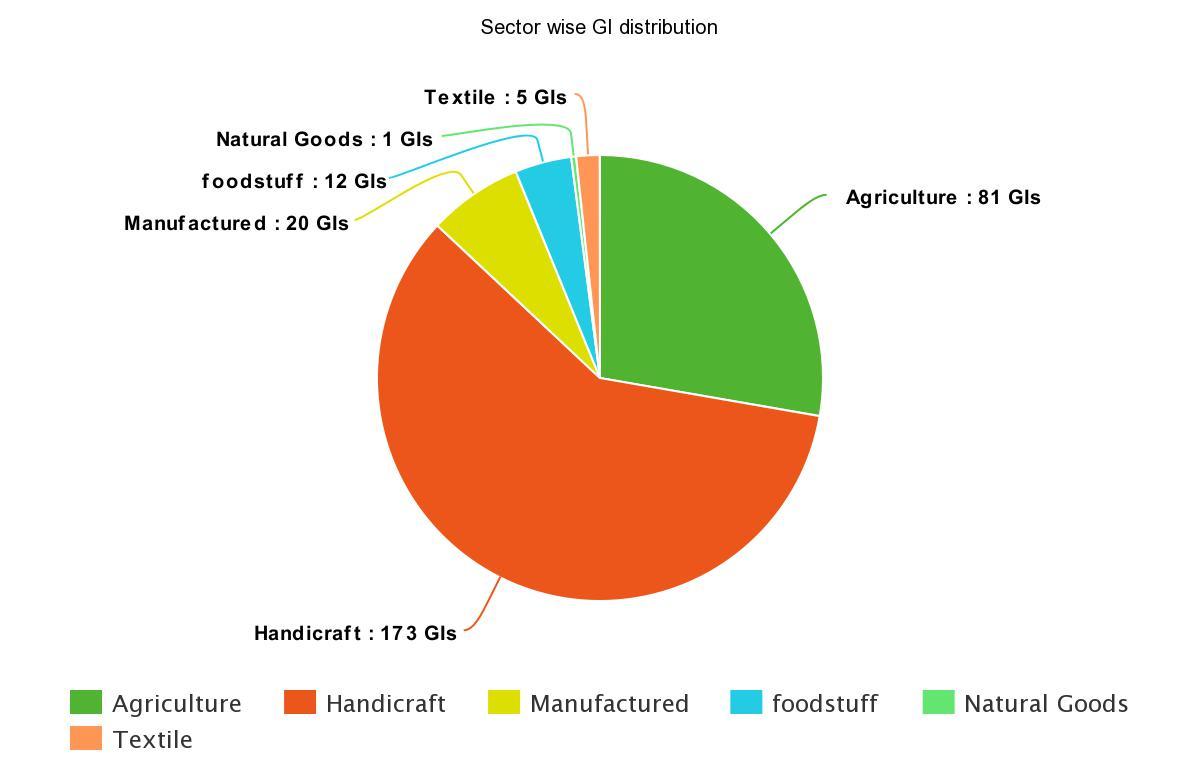

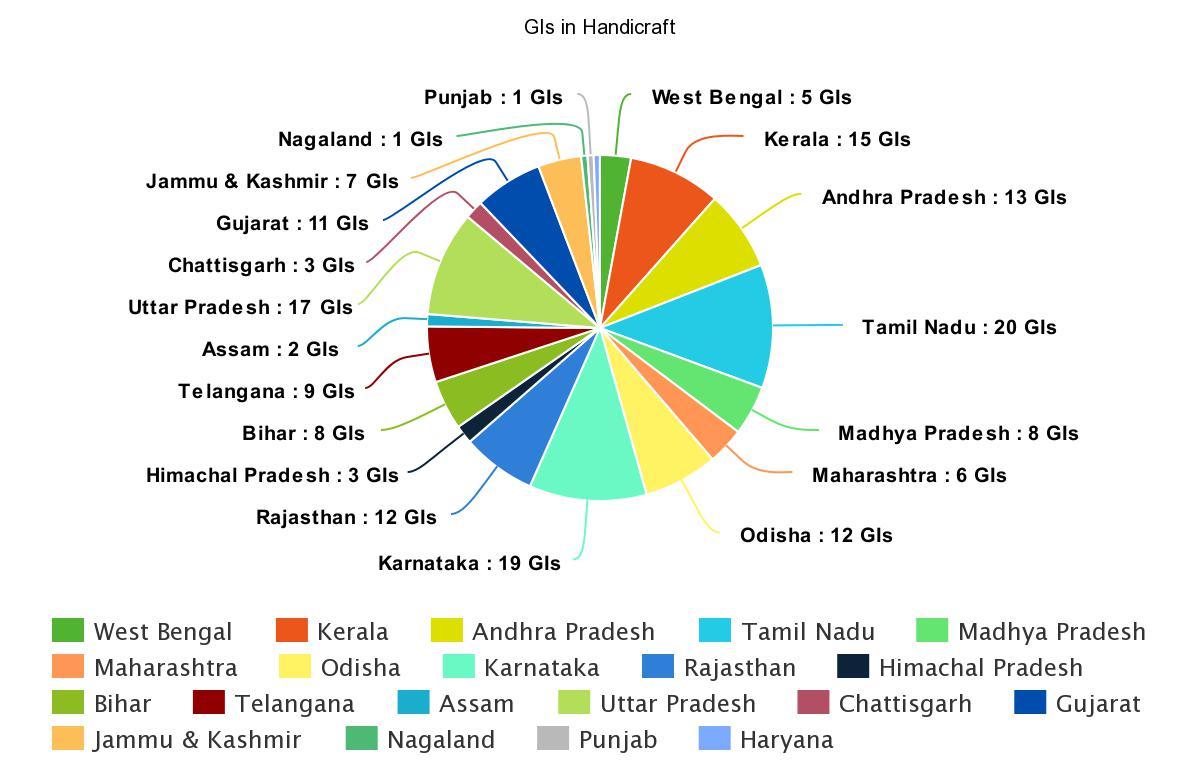
GIs on Handicrafts alone contribute 57.4% out of the total registered GIs in India. The state of Tamil Nadu tops the GI’s state list of Handicraft with 20 registered GIs. Beautiful reed Pattamadai mats crafted out of korai grass, distinctively designed Kanchipuram Saris, Chola Bronzes and Tanjore Gold Leaf Painting which are simply the apogee of excellence and are renowned worldwide are covered under GI protection. The second is the state of Karnataka with 19 registered GIs. Uttar Pradesh, Kerala, Andhra Pradesh and Rajasthan comes on third, fourth, fifth and sixth position respectively with 17,15,13,12 registered GIs.
After Handicrafts comes the Agricultural sector which contributes to total 26.9% GIs. Maharashtra and Karnataka leads with 23 and 16 registered GIs respectively. The state of Uttar Pradesh which in area is the fifth largest state of India and have a vast fertile land and a great diversity of flora has just 5 registered GI while the state of Madhya Pradesh which is the second largest and have a good reputation in agriculture is currently nowhere in the GI list. This is the reason why the name of the famous Sharbati wheet of M.P. is being used continuously by the big FMCG companies to sell their flour at the premium prices.

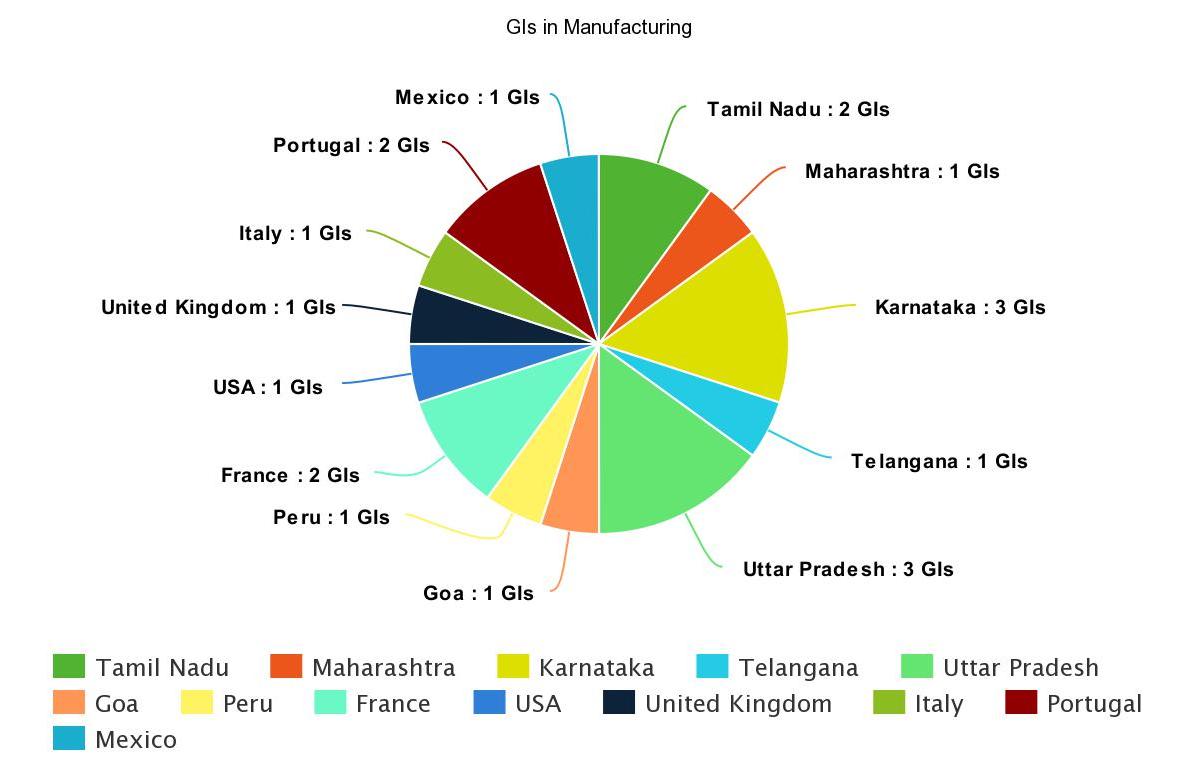
Under Manufactured goods there are very few states having registered GIs. Uttar Pradesh and Karnataka are the two both having 3 registered GIs. Kannauj Perfume, Kanpur Saddlery and Meerut Scissors are the old names in the list. There are also some foreign manufactured items which are registered as GI in India. Among them are mostly alcoholic beverages which include Peruvian Pisco, an alcoholic beverage belonging to a variety of grape aguardiente produced in Peru, Champagne and Cognac of France, Napa Valley of USA, Scotch Whisky of UK, Porto of Portugal , etc.
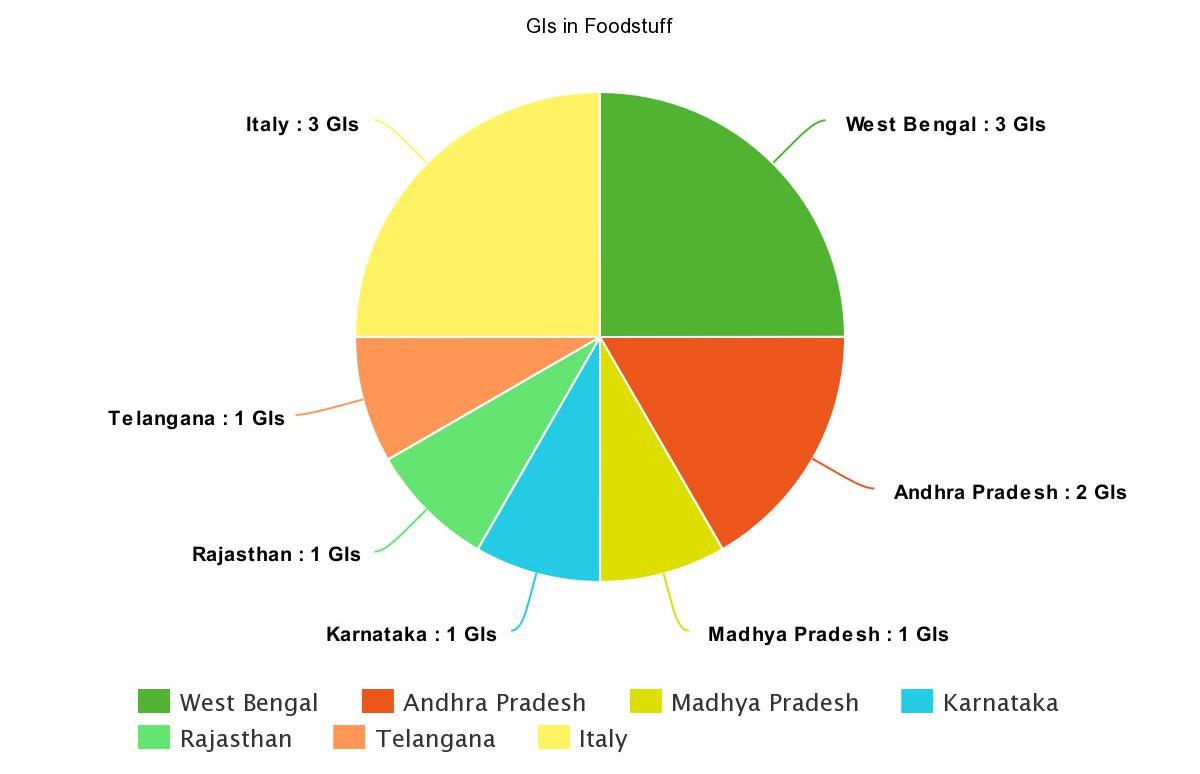
After Manufacturing comes foodstuff contributing 3.9% of registered GIs. Although India has a rich culture and a great variety of foodstuff which are appreciated worldwide, the percentage contribution in this sector is surprisingly low. West Bengal tops the list with just 3 registered GIs. Bardhaman city in West Bengal alone have two registered GI and both on sweet namely Bardhaman Sitabhog and Bardhaman Mihidana. Rajasthan having multitude of royal cuisines but just one registered GI on Bikaneri Bhujia. Madhya Pradesh too have just one registered GI on Ratlami Sev while there are many cuisines like Indori Poha, Usal Poha, Lal balti ki kachori which have a great business potential if registered under GI and promoted by the state government. Italy have 3 registered GI in India namely on Prosciutto di Parma, a dry-cured ham that is usually thinly sliced and served uncooked of specially selected heritage breed pigs raised in 11 regions of Italy, Parmigiano Reggiano or Parmesan cheese prepared from unpasteurized cow’s milk and Asiago cheese known for its crumbly texture.
Under the Natural Goods classification only Makrana Marble of Rajasthan is registered which is one of the two calcitic marble varieties in India, having a high percentage of calcium and is therefore resistant to water seepage and known for its usage in Taj Mahal one of the wonders of Medieval World. Makrana marble was given the geographical indication status in 2015 by the Geographical Indication Registry, Chennai. Marble from Makrana is exported abroad basically to the Persian Gulf nations, the European Union, Southeast Asia, Canada, Pakistan and Russia. In India, it is principally utilized for handicraft and sculpture, aside from development of structures.

Current GI scenario in India and how to register for a new GI
India’s GI Act does not lay much accentuation on investigation and monitoring mechanisms for GI security. Quality related with topographical beginning is the sign of a GI and the current lawful system clearly needs teeth to guarantee it. This may clarifies why one has not known about many GI success stories in India.
The present Indian legitimate structure for GIs should be reinforced to address quality control and consumer expectations by demanding multi-layered quality control frameworks as a precondition for enrollment. Other essential issues faced by GI maker bodies are market access and financing for implementation and advertising. India must hand-hold maker bodies, take a gander at fruitful models of somewhere else and shape these to suit the ground realities.
In India, any association of persons, producers, organization or authority established by or under the law can apply for GI. The applicant must represent the interests of the producers of the concerned goods. An application for registration of geographical indication shall be in prescribed Form (Form GI-1 for the registration of a Geographical Indication in Part A of the Register by an Indian applicant; Form GI-2 for a convention application; an application for goods falling in different classes by an Indian applicant in GI-3 and an application for registration of goods falling in different classes from a convention country in Form GI-4).
The application should include the various requirements and criteria for processing a geographical application as follows:
- How the indication serves to designate the goods as a GI?
- The Class of goods;
- The territory;
- The particulars of appearance;
- Particulars of producers;
- An affidavit of how the applicant claim to represent the interest;
- The standard bench mark or other characteristics of the GI;
- The particulars of special characteristics;
- Textual description of the proposed boundary;
- The growth attributes in relation to the G.I. pertinent to the application;
- Certified copies of the map of the territory
- Special human skill involved, if any;
- Number of producers; and
- Particulars of inspection structures, if any, to regulate the use of GI.
Upon filing of the application accompanied by prescribed fees, a number will be alloted. The application would be examined on turn to check whether it meets the requirements of the GI Act and Rules. After issuance of the Examination Report submission would be considered. If no objections is raised it would be accepted and would be advertised in the Geographical Indications Journal. An opposition can be lodged within a maximum of four month period. If the opposition is dismissed, the application will proceed to registration in Part A of the Register.
After a geographical indication is registered any person claiming to be the producer of the registered geographical indication can file an application for registration as an authorised user in Part B of the Register.
The term of a geographical indications registration is for a period of ten years. The renewal is possible for further period of 10 years each. If a registered geographical indication is not renewed, it is liable to be removed from the register.
The Act also provides criminal remedies. First, the intentional falsification of a geographical indications will bear a prison sentence of at least six months. This may be extended to three years and be accompanied by a fine. Second, the police may conduct search and seizure operations without any warrant. In essence, unauthorized parties may not use geographical indications if such use is likely to mislead the public as to the true origin of the product.
Sources :
Ease of building Patent Search Platform now with Google Patents Public Datasets
Now patent data got cheaper with the launch of new Patents Public Datasets by Google based on the company’s owned enterprise data warehouse BigQuery, which gathers openly available, associated database tables for exact investigation of the worldwide patent framework.
Enterprises often keep up accumulations of private information about patents, for example internal tagging system that compares to particular product offerings, and they need to associate that data with other patent datasets to create reports and examine speculation zones. Now organizations can consolidate their private information with open and paid datasets to ask “what are my active patents and pending patent applications?”, “which of my patents in what technological areas are lapsing soon?” or “what are the best organizations that refer to the patents I’ve labeled with [widget #57]?”.
Patent data availability is basis for analyzing new patents, illuminating open approach choices, overseeing corporate interest in protected innovation, and advancing future logical advancement. The developing number of accessible patent information sources implies specialists frequently invest more energy downloading, parsing, stacking, matching up and overseeing nearby databases than leading examination. With these new datasets, specialists and organizations can get to the information they require from different sources in a single place, in this way investing more energy in examination than data preparation.
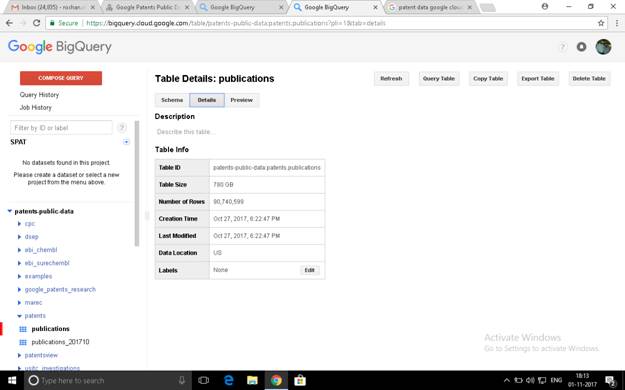
| Table ID | patents-public-data:patents.publications |
| Table Size | 780 GB |
| Number of Rows | 90,740,599 |
| Creation Time | Oct 27, 2017, 6:22:47 PM |
| Last Modified | Oct 27, 2017, 6:22:47 PM |
| Data Location | US |
| Labels | NoneEdit |
Table Details: publications
Refresh Query Table Copy Table Export Table Delete Table
| publication_number | STRING | NULLABLE | Patent publication number (DOCDB compatible), eg: ‘US-7650331-B1’ |
| application_number | STRING | NULLABLE | Patent application number (DOCDB compatible), eg: ‘US-87124404-A’. This may not always be set. |
| country_code | STRING | NULLABLE | Country code, eg: ‘US’, ‘EP’, etc |
| kind_code | STRING | NULLABLE | Kind code, indicating application, grant, search report, correction, etc. These are different for each country. |
| application_kind | STRING | NULLABLE | High-level kind of the application: A=patent; U=utility; P=provision; W= PCT; F=design; T=translation. |
| application_number_formatted | STRING | NULLABLE | Application number, formatted to the patent office format where possible. |
| pct_number | STRING | NULLABLE | PCT number for this application if it was part of a PCT filing, eg: ‘PCT/EP2008/062623’. |
| family_id | STRING | NULLABLE | Family ID (simple family). Grouping on family ID will return all publications associated with a simple patent family (all publications share the same priority claims). |
| title_localized | RECORD | REPEATED | The publication titles in different languages |
| title_localized.text | STRING | NULLABLE | Localized text |
| title_localized.language | STRING | NULLABLE | Two-letter language code for this text |
| abstract_localized | RECORD | REPEATED | The publication abstracts in different languages |
| abstract_localized.text | STRING | NULLABLE | Localized text |
| abstract_localized.language | STRING | NULLABLE | Two-letter language code for this text |
| claims_localized | RECORD | REPEATED | For US publications only, the claims |
| claims_localized.text | STRING | NULLABLE | Localized text |
| claims_localized.language | STRING | NULLABLE | Two-letter language code for this text |
| description_localized | RECORD | REPEATED | For US publications only, the description, limited to the first 9 megabytes |
| description_localized.text | STRING | NULLABLE | Localized text |
| description_localized.language | STRING | NULLABLE | Two-letter language code for this text |
| publication_date | INTEGER | NULLABLE | The publication date. |
| filing_date | INTEGER | NULLABLE | The filing date. |
| grant_date | INTEGER | NULLABLE | The grant date, or 0 if not granted. |
| priority_date | INTEGER | NULLABLE | The earliest priority date from the priority claims, or the filing date. |
| priority_claim | RECORD | REPEATED | The application numbers of the priority claims of this publication. |
| priority_claim.publication_number | STRING | NULLABLE | Same as [publication_number] |
| priority_claim.application_number | STRING | NULLABLE | Same as [application_number] |
| priority_claim.npl_text | STRING | NULLABLE | Free-text citation (non-patent literature, etc). |
| priority_claim.type | STRING | NULLABLE | The type of reference (see parent field for values). |
| priority_claim.category | STRING | NULLABLE | The category of reference (see parent field for values). |
| priority_claim.filing_date | INTEGER | NULLABLE | The filing date. |
| inventor | STRING | REPEATED | The inventors. |
| inventor_harmonized | RECORD | REPEATED | The harmonized inventors and their countries. |
| inventor_harmonized.name | STRING | NULLABLE | Name |
| inventor_harmonized.country_code | STRING | NULLABLE | The two-letter country code |
| assignee | STRING | REPEATED | The assignees/applicants. |
| assignee_harmonized | RECORD | REPEATED | The harmonized assignees and their countries. |
| assignee_harmonized.name | STRING | NULLABLE | Name |
| assignee_harmonized.country_code | STRING | NULLABLE | The two-letter country code |
| examiner | RECORD | REPEATED | The examiner of this publication and their countries. |
| examiner.name | STRING | NULLABLE | Name |
| examiner.department | STRING | NULLABLE | The examiner’s department |
| examiner.level | STRING | NULLABLE | The examiner’s level |
| uspc | RECORD | REPEATED | The US Patent Classification (USPC) codes. |
| uspc.code | STRING | NULLABLE | Classification code |
| uspc.inventive | BOOLEAN | NULLABLE | Is this classification inventive/main? |
| uspc.first | BOOLEAN | NULLABLE | Is this classification the first/primary? |
| uspc.tree | STRING | REPEATED | The full classification tree from the root to this code |
| ipc | RECORD | REPEATED | The International Patent Classification (IPC) codes. |
| ipc.code | STRING | NULLABLE | Classification code |
| ipc.inventive | BOOLEAN | NULLABLE | Is this classification inventive/main? |
| ipc.first | BOOLEAN | NULLABLE | Is this classification the first/primary? |
| ipc.tree | STRING | REPEATED | The full classification tree from the root to this code |
| cpc | RECORD | REPEATED | The Cooperative Patent Classification (CPC) codes. |
| cpc.code | STRING | NULLABLE | Classification code |
| cpc.inventive | BOOLEAN | NULLABLE | Is this classification inventive/main? |
| cpc.first | BOOLEAN | NULLABLE | Is this classification the first/primary? |
| cpc.tree | STRING | REPEATED | The full classification tree from the root to this code |
| fi | RECORD | REPEATED | The FI classification codes. |
| fi.code | STRING | NULLABLE | Classification code |
| fi.inventive | BOOLEAN | NULLABLE | Is this classification inventive/main? |
| fi.first | BOOLEAN | NULLABLE | Is this classification the first/primary? |
| fi.tree | STRING | REPEATED | The full classification tree from the root to this code |
| fterm | RECORD | REPEATED | The F-term classification codes. |
| fterm.code | STRING | NULLABLE | Classification code |
| fterm.inventive | BOOLEAN | NULLABLE | Is this classification inventive/main? |
| fterm.first | BOOLEAN | NULLABLE | Is this classification the first/primary? |
| fterm.tree | STRING | REPEATED | The full classification tree from the root to this code |
| citation | RECORD | REPEATED | The citations of this publication. Category is one of {CH2 = Chapter 2; SUP = Supplementary search report ; ISR = International search report ; SEA = Search report; APP = Applicant; EXA = Examiner; OPP = Opposition; 115 = article 115; PRS = Pre-grant pre-search; APL = Appealed; FOP = Filed opposition}, Type is one of {A = technological background; D = document cited in application; E = earlier patent document; 1 = document cited for other reasons; O = Non-written disclosure; P = Intermediate document; T = theory or principle; X = relevant if taken alone; Y = relevant if combined with other documents} |
| citation.publication_number | STRING | NULLABLE | Same as [publication_number] |
| citation.application_number | STRING | NULLABLE | Same as [application_number] |
| citation.npl_text | STRING | NULLABLE | Free-text citation (non-patent literature, etc). |
| citation.type | STRING | NULLABLE | The type of reference (see parent field for values). |
| citation.category | STRING | NULLABLE | The category of reference (see parent field for values). |
| citation.filing_date | INTEGER | NULLABLE | The filing date. |
| entity_status | STRING | NULLABLE | The USPTO entity status (large, small). |
| art_unit | STRING | NULLABLE | The USPTO art unit performing the examination (2159, etc). |
These datasets incorporates Google Patents Public Data table containing worldwide bibliographic information on more than 90 million patent publications from 17 countries and US full text, provided by IFI CLAIMS Patent Services. Along with this Google is also providing a Google Patents Research Data table containing English machine translations for all titles and abstracts from Google Translate, similarity vectors, extracted top terms, and more. Common research datasets from patents, chemistry, and litigation have also been uploaded. Users can get to data gathered by different analysts and patent information suppliers in a similar database, and blend them with private information to create reports or research queries with the full opportunity of SQL, without setting up their very own database.
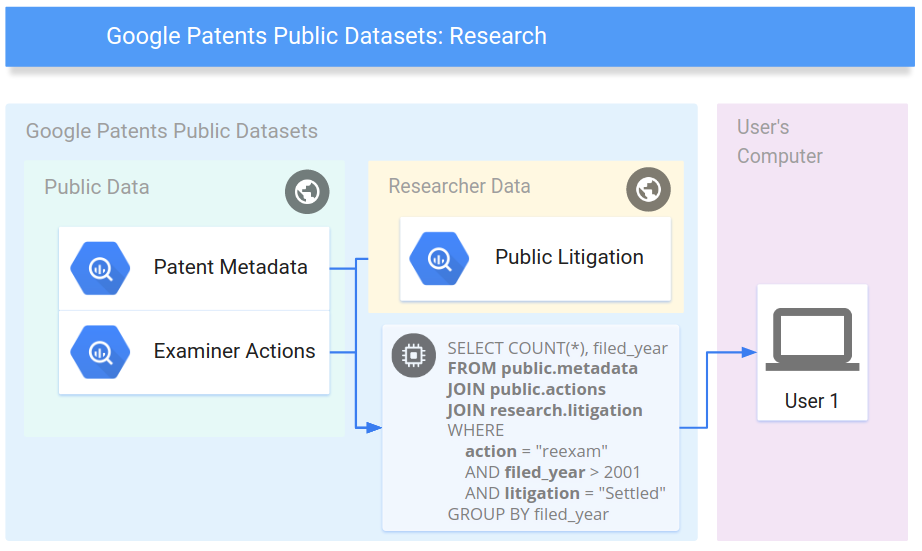
Commercial Data providers are also making their patent data available for purchase in BigQuery, starting with IFI CLAIMS Patent Data Enrichments including legal status information and standardized assignee names. Accessing these datasets through BigQuery gives users an up-to-date database managed by data providers, so users get the flexibility of a database without the engineering cost of maintaining one. Getting to these datasets through BigQuery surrenders clients a to-date database oversaw by information suppliers, so clients get the adaptability of a database without the designing expense of looking after one.
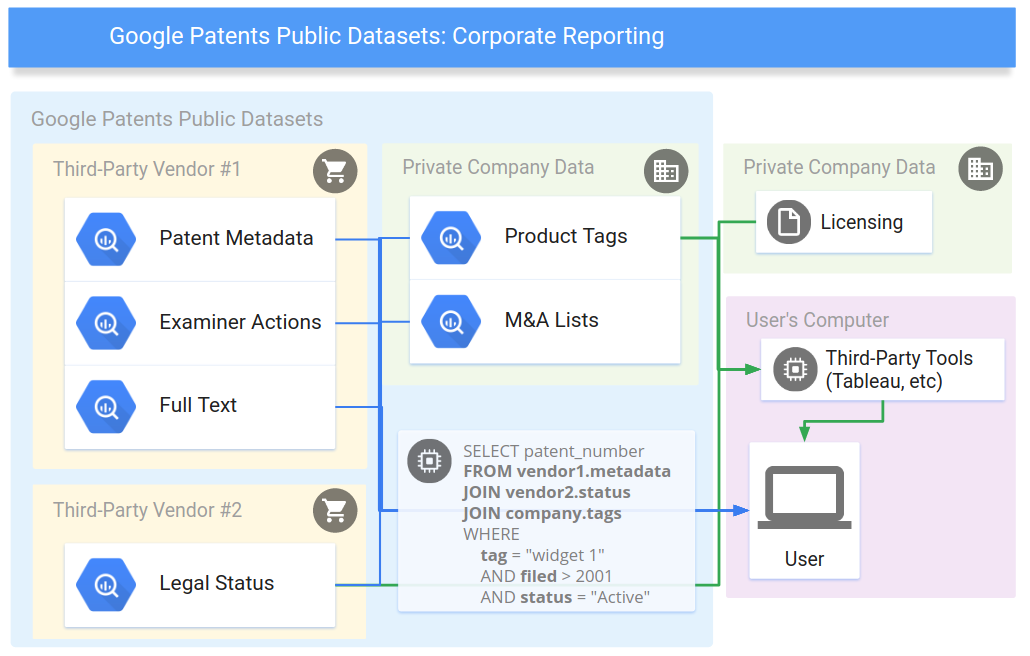
Several third party tools such as Tableau and Looker that can access BigQuery can also be employed which provide much easier interface for accessing database than SQL. For corporate having classified data that cannot leave their network, some of these tools can be used to fetch from the BigQuery and process that in conjunction to sensitive data.
BigQuery for Data Providers
For data providers, BigQuery is an extraordinary approach to pitch information in a right away helpful configuration to clients. The commonplace choices for information dissemination are either in bulk format through CSV/XML downloads, or through a web interface, yet both have drawbacks. Bulk format permit adaptability to the detriment of the client programming and keeping up their own databases, while web interfaces are anything but difficult to get to, however can’t undoubtedly be reached out with new paid or private wellsprings of information, and have a settled arrangement of conceivable approaches to question and show the information. Presently clients can get a similar adaptability of a database with the simple access of a web interface to associate private information and show it in dashboards and other visualization tools.