Draft National Educational Policy of India 2019

The Committee led by the Chairman Dr. Kasturirangan submitted the Draft National Educational Policy to the Union Human Resource Development Minister, Shri Ramesh Pokhriyal ‘Nishank’ and Minister of State for HRD, Shri Sanjay Shamrao Dhotre in New Delhi today in the presence of Shri R. Subrahmanyam, Secretary Department of Higher Education and Smt. Rina Ray, Secretary Department of School Education & Literacy and other senior officials of the Ministry.


The Government of India had initiated the process of formulating a New Education Policy to meet the changing dynamics of the requirements of the population with regard to quality education, innovation and research, aiming to make India a knowledge superpower by equipping its students with the necessary skills and knowledge and to eliminate the shortage of manpower in science, technology, academics and industry. The extant National Policy on Education, 1986 modified in 1992 required changes to meet the contemporary and futuristic needs of our large youth population.


For this, the MHRD initiated an unprecedented collaborative, multi-stakeholder, multi-pronged, bottom- up people-centric, inclusive, participatory consultation process. The extensive consultations undertaken across multiple levels of online, expert and thematic, and from the grassroots ranging from Village, Block, Urban Local bodies, District, State, Zonal and the National level, provided an opportunity to every citizen to engage in this massive exercise. Several in-person and in-depth deliberations across a wide spectrum of stakeholders were held. Subsequently, a ‘Committee for Evolution of the New Education Policy’ under the Chairmanship of Late Shri T.S.R. Subramanian, Former Cabinet Secretary, was constituted, which submitted its report in May, 2016. Based on this report, the Ministry prepared ‘Some Inputs for the Draft National Education Policy, 2016’.


The Committee had the onerous task of analysing and examining a humungous volume of suggestions, inputs, reports, and outcome documents that preceded its own efforts. The underlying spirit that dictated the Committee’s own course of crafting this significant document was primarily to bring out a vision document which will hold the test of time for at least another 20 years. The Draft National Education Policy, 2019 is built on the foundational pillars of Access, Equity, Quality, Affordability and Accountability. The Committee has proposed to rename MHRD as Ministry of Education (MoE).

In School Education, a major reconfiguration of curricular and pedagogical structure with Early Childhood Care and Education (ECCE) as an integral part of school education is proposed. The Committee also recommends Extension of Right to Education Act 2009 to cover children of ages 3 to 18. A 5+3+3+4 curricular and pedagogical structure based on cognitive and socio-emotional developmental stages of children: Foundational Stage (age 3-8 yrs): 3 years of pre-primary plus Grades 1-2;  Preparatory Stage (8-11 years): Grades 3-5; Middle Stage (11-14 years): Grades 6-8;  and Secondary Stage (14-18 years): Grades 9-12. Schools will be re-organized into school complexes. It also seeks to reduce content load in school education curriculum. There will be no hard separation of learning areas in terms of curricular, co-curricular or extra- curricular areas and all subjects, including arts, music, crafts, sports, yoga, community service, etc. will be curricular.  It promotes active pedagogy that will focus on the development of core capacities: and life skills, including 21st century skills.

The Committee proposes for massive transformation in Teacher Education by shutting down sub-standard teacher education institutions and moving all teacher preparation/education programmes into large multidisciplinary universities/colleges. The 4-year integrated stage-specific B.Ed. programme will eventually be the minimum degree qualification for teachers.

In higher education, a restructuring of higher education institutions with three types of higher education institutions is proposed- Type 1: Focused on world-class research and high quality teaching; Type 2: Focused on high quality teaching across disciplines with significant contribution to research; Type 3: High quality teaching focused on undergraduate education. This will be driven by two Missions -Mission Nalanda & Mission Takshashila. There will be re-structuring of Undergraduate programs (e.g. BSc, BA, BCom, BVoc) of 3 or 4 years duration and having multiple exit and entry options.

A new apex body Rashtriya Shiksha Ayog is proposed to enable a holistic and integrated implementation of all educational initiatives and programmatic interventions, and to coordinate efforts between the Centre and States. The National Research Foundation, an apex body is proposed for creating a strong research culture and building research capacity across higher education.

The four functions of Standard setting, Funding, Accreditation and Regulation to be separated and conducted by independent bodies: National Higher Education Regulatory Authority as the only regulator for all higher education including professional education; Creation of accreditation eco-system led by revamped NAAC; Professional Standard Setting Bodies for each area of professional education and UGC to transform to Higher Education Grants Commission (HEGC). The private and public institutions will be treated on par and education will remain a ‘not for profit’ activity.

Several new policy initiatives for promoting internationalization of higher education, strengthening quality open and distance learning,  technology integration at all levels of education, adult and lifelong learning  and initiatives to enhance participation of under-represented groups, and eliminate gender, social category and regional gaps in education outcomes are recommended. Promotion of Indian and Classical Languages and setting up three new National Institutes for Pali, Persian and Prakrit and an Indian Institute of Translation and Interpretation (IITI) has been recommended. The path breaking reforms recommended will bring about a paradigm shift by equipping our students, teachers and educational institutions with the right competencies and capabilities and also create an enabling and reinvigorated educational eco-system for a vibrant new India.

The draft NEP (Hindi & English) is given at links below::

https://mhrd.gov.in/sites/upload_files/mhrd/files/Draft_NEP_2019_EN.pdf

https://mhrd.gov.in/sites/upload_files/mhrd/files/Draft_NEP_2019_HI.pdf

Initiative to crush Indian pharma generic industry #PatINFORMED

@WIPO & @IFPMA launch #PatINFORMED – a new online tool designed to help procurement agencies better understand the global #patent status of #medicines
The Patent Information Initiative for Medicines (Pat-INFORMED) is a resource where patent holders provide information about patents covering approved medicines through a free, open access database.
This database became operational today, along with a platform where procurement agencies can make direct enquiries to companies.
Pat-INFORMED is a partnership between WIPO and the International Federation of Pharmaceutical Manufacturers and Associations, IFPMA, the global trade association representing the research-based pharmaceutical industry. Pat-INFORMED originated in the industry’s efforts to add clarity to patent information about
WIPO is hosting the database and providing the resources to ensure its continued development, while IFPMA is working closely with the 20 leading research-based biopharmaceutical companies that have backed this initiative to help ensure a consistent and coordinated approach.
While information about patent applications and grants reside in the public domain, resources that directly link patents to medicines already on the market are scarce and limited. Tools that directly link granted patents to medicines are only available publicly in certain countries (e.g. the USA’s ‘Orange Book’) or through private third-party databases. Pat-INFORMED aims to help close these gaps and make patent research easier, faster and more accessible to a wider array of health workers.
Important issue which is against generic industry is thay Pat-INFORMED also offers procurement agencies a direct communication channel for follow-on enquiries to participating companies. Each of the participating companies, currently 20, has agreed to engage in discussions with official procurement agencies that are seeking more detailed information about granted patents on specific products.
So far, Pat-INFORMED houses information on over 14,000 individual patents, for 600 patent families and 169 INNs, unique names that are globally recognized and used to identify pharmaceutical substances or active pharmaceutical ingredients within medicines that cover a wide range of conditions.
This initiative is a practical way of reducing the complexity around access to patent information, something health experts have long been calling for. By easing access to patent information for public health authorities, Pat-INFORMED other objective which is against the generic industry is that its main focus is on procurement options available to health agency and government of developing and least deceloping nation which will definetly give negative impact generic contribution to global health.

What is SSL and why you need it now?

Data transferred in plain-text form or in non-encrypted format can be intercepted, eavesdropped, compromised and stolen. Transactions performed online may involve submitting personal information such as credit card information, social security numbers, usernames and passwords. Cybercriminals who intercept unencrypted communications will gain full access to this data and can use it for fraudulent purchases and activities.

Trust and security are what make individuals sufficiently certain to give private, sensitive data on the web. SSL authentications are what make a site trusted. SSL stands for Secure Sockets Layer, the protocol which provides encrypted communications between a website and an internet browser. SSL Certificates are small data files that digitally bind a cryptographic key to an organization’s details and are typically installed on pages which ensure that any data transferred between users and sites, or between two systems remain impossible to read. It safeguards sensitive data being sent between two systems like credit card details or passwords, exchanged during each visit, which is called a session, from being intercepted from non-authorized parties. The two systems can be a server and a client (for example, a shopping website and browser) or server to server (for example, an application with personal identifiable information or with payroll information).

HTTPS (Hyper Text Transfer Protocol Secure) appears in the URL when a website is secured by an SSL certificate. The details of the certificate, including the issuing authority and the corporate name of the website owner, can be viewed by clicking on the lock symbol on the browser bar.

How it works:

The Secure Socket Layer protocol was originally created by Netscape. The protocol uses a third party, a Certificate Authority (CA), to identify one end or both end of the transactions. Let see how it works:

  • A browser requests a secure page (usually https://).
  • The web server sends its public key with its certificate.
  • The browser verifies that the certificate was issued by a trusted party (more often a trusted root CA), that the certificate is as yet legitimate and that the certificate is identified with the site reached.
  • The browser at that point utilizes public key, to scramble a random symmetric encryption key and sends it to the server with the encoded URL required and additionally other encoded http data.
  • The web server decodes the symmetric encryption key utilizing its private key and uses the symmetric key to unscramble the URL and http data.
  • The web server sends back the asked for html archive and http information scrambled with the symmetric key.
  • The program decodes the http information and html report utilizing the symmetric key and shows the data.

Thus the encryption using a private key/public key pair ensures that the data can be encrypted by one key but can only be decrypted by the other key pair. The keys are comparative in nature and can be utilized on the other hand: what one key encode, the other key pair can decode. The key pair depends on prime numbers and their length as far as bits guarantees the trouble of having the capacity to unscramble the message without the key sets. The trick in a key pair is to keep one key mystery (the private key) and to circulate the other key (the public key) to everyone. Anyone can send you a scrambled message, that lone you will have the capacity to decode.

Type of Certificates:

There are three basic sorts of certificates. Picking the correct one will be based on the level of security your site needs, for example domain-validated (low in security), organization-validated (medium), extended validation (high); property types you wish to protect (domain, sub-domain) and number of properties for which you need protection (wildcard or multiple domain).

  • Standard SSL & Extended Validation (EV) SSL – Standard SSL and EV SSL are both single-domain SSL (Secure Sockets Layer) certificate but the later ensures highest degree of authentication and requires more evaluation and documentation checks for applicant websites than the other.
  • Multi-Domain SSL – It offers the highest degree of authentication and protection using one certificate for many domains and sub domains.
  • Wildcard SSL – a Subject Alternative Names (SANs) secured Wildcard is a top choice for organizations managing multiple sites hosted across numerous sub domains.

Google’s disciplinary measures for non SSL websites:

For a considerable length of time, Google has been actively looking for approaches to urge site proprietors to actualize SSL certificates. Earlier Google follows a reward scheme in which it began ranking websites higher in search results if they had an SSL Certificate installed. At that time, SSL certificate was mandatory for web based business sites that acknowledged online buys and took users credit card details.

Recently, Google has moved from a reward system to a punitive one. Few months back, Google was blacklisting non-HTTPS websites that allowed password fields and credit card forms to be filled. From October, 2017 onwards Google Chrome browser began showing a “not secure” message on all websites that were running without an SSL certificate. In any case, with site security more essential than any time in recent memory, Google has chosen to “drive” all website owners to include this additional level of security, or pay the cost.

We’re here to help

If you’d like to talk further about your website’s security and how this might impact your business, we’re always available to help. Contact our office and speak to one of our friendly consultants should you have any questions.

References:

  1. http://www.tldp.org/HOWTO/SSL-Certificates-HOWTO/x64.html
  2. https://www.instantssl.com/ssl-certificate.html


Ease of building Patent Search Platform now with Google Patents Public Datasets

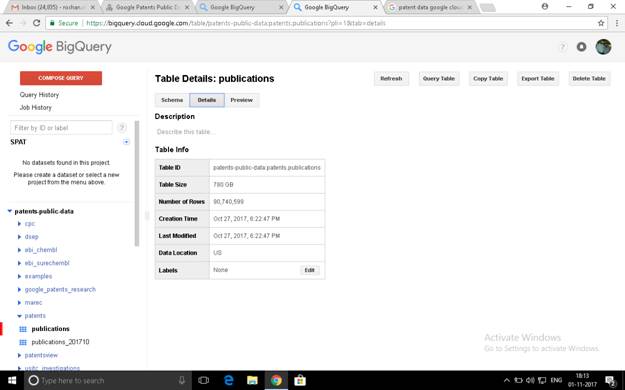
Now patent data got cheaper with the launch of new Patents Public Datasets by Google based on the company’s owned enterprise data warehouse BigQuery, which gathers openly available, associated database tables for exact investigation of the worldwide patent framework.

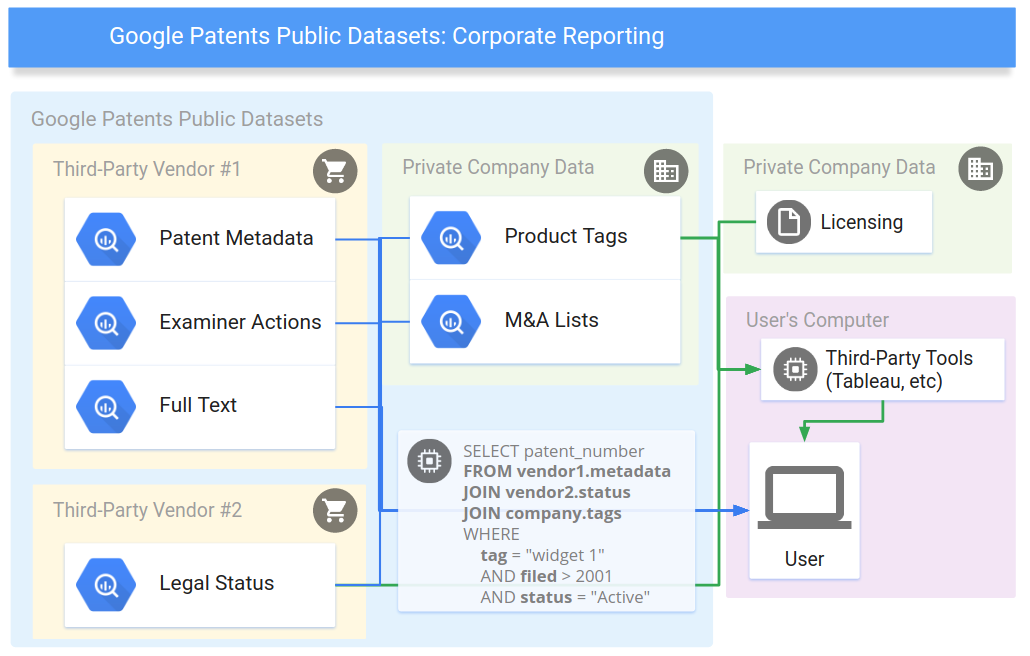
Enterprises often keep up accumulations of private information about patents, for example internal tagging system that compares to particular product offerings, and they need to associate that data with other patent datasets to create reports and examine speculation zones. Now organizations can consolidate their private information with open and paid datasets to ask “what are my active patents and pending patent applications?”, “which of my patents in what technological areas are lapsing soon?” or “what are the best organizations that refer to the patents I’ve labeled with [widget #57]?”.

Patent data availability is basis for analyzing new patents, illuminating open approach choices, overseeing corporate interest in protected innovation, and advancing future logical advancement. The developing number of accessible patent information sources implies specialists frequently invest more energy downloading, parsing, stacking, matching up and overseeing nearby databases than leading examination. With these new datasets, specialists and organizations can get to the information they require from different sources in a single place, in this way investing more energy in examination than data preparation.

3

Table ID patents-public-data:patents.publications
Table Size 780 GB
Number of Rows 90,740,599
Creation Time Oct 27, 2017, 6:22:47 PM
Last Modified Oct 27, 2017, 6:22:47 PM
Data Location US
Labels NoneEdit


Table Details: publications

Refresh Query Table Copy Table Export Table Delete Table

publication_number STRING NULLABLE Patent publication number (DOCDB compatible), eg: ‘US-7650331-B1’
application_number STRING NULLABLE Patent application number (DOCDB compatible), eg: ‘US-87124404-A’. This may not always be set.
country_code STRING NULLABLE Country code, eg: ‘US’, ‘EP’, etc
kind_code STRING NULLABLE Kind code, indicating application, grant, search report, correction, etc. These are different for each country.
application_kind STRING NULLABLE High-level kind of the application: A=patent; U=utility; P=provision; W= PCT; F=design; T=translation.
application_number_formatted STRING NULLABLE Application number, formatted to the patent office format where possible.
pct_number STRING NULLABLE PCT number for this application if it was part of a PCT filing, eg: ‘PCT/EP2008/062623’.
family_id STRING NULLABLE Family ID (simple family). Grouping on family ID will return all publications associated with a simple patent family (all publications share the same priority claims).
title_localized RECORD REPEATED The publication titles in different languages
title_localized.text STRING NULLABLE Localized text
title_localized.language STRING NULLABLE Two-letter language code for this text
abstract_localized RECORD REPEATED The publication abstracts in different languages
abstract_localized.text STRING NULLABLE Localized text
abstract_localized.language STRING NULLABLE Two-letter language code for this text
claims_localized RECORD REPEATED For US publications only, the claims
claims_localized.text STRING NULLABLE Localized text
claims_localized.language STRING NULLABLE Two-letter language code for this text
description_localized RECORD REPEATED For US publications only, the description, limited to the first 9 megabytes
description_localized.text STRING NULLABLE Localized text
description_localized.language STRING NULLABLE Two-letter language code for this text
publication_date INTEGER NULLABLE The publication date.
filing_date INTEGER NULLABLE The filing date.
grant_date INTEGER NULLABLE The grant date, or 0 if not granted.
priority_date INTEGER NULLABLE The earliest priority date from the priority claims, or the filing date.
priority_claim RECORD REPEATED The application numbers of the priority claims of this publication.
priority_claim.publication_number STRING NULLABLE Same as [publication_number]
priority_claim.application_number STRING NULLABLE Same as [application_number]
priority_claim.npl_text STRING NULLABLE Free-text citation (non-patent literature, etc).
priority_claim.type STRING NULLABLE The type of reference (see parent field for values).
priority_claim.category STRING NULLABLE The category of reference (see parent field for values).
priority_claim.filing_date INTEGER NULLABLE The filing date.
inventor STRING REPEATED The inventors.
inventor_harmonized RECORD REPEATED The harmonized inventors and their countries.
inventor_harmonized.name STRING NULLABLE Name
inventor_harmonized.country_code STRING NULLABLE The two-letter country code
assignee STRING REPEATED The assignees/applicants.
assignee_harmonized RECORD REPEATED The harmonized assignees and their countries.
assignee_harmonized.name STRING NULLABLE Name
assignee_harmonized.country_code STRING NULLABLE The two-letter country code
examiner RECORD REPEATED The examiner of this publication and their countries.
examiner.name STRING NULLABLE Name
examiner.department STRING NULLABLE The examiner’s department
examiner.level STRING NULLABLE The examiner’s level
uspc RECORD REPEATED The US Patent Classification (USPC) codes.
uspc.code STRING NULLABLE Classification code
uspc.inventive BOOLEAN NULLABLE Is this classification inventive/main?
uspc.first BOOLEAN NULLABLE Is this classification the first/primary?
uspc.tree STRING REPEATED The full classification tree from the root to this code
ipc RECORD REPEATED The International Patent Classification (IPC) codes.
ipc.code STRING NULLABLE Classification code
ipc.inventive BOOLEAN NULLABLE Is this classification inventive/main?
ipc.first BOOLEAN NULLABLE Is this classification the first/primary?
ipc.tree STRING REPEATED The full classification tree from the root to this code
cpc RECORD REPEATED The Cooperative Patent Classification (CPC) codes.
cpc.code STRING NULLABLE Classification code
cpc.inventive BOOLEAN NULLABLE Is this classification inventive/main?
cpc.first BOOLEAN NULLABLE Is this classification the first/primary?
cpc.tree STRING REPEATED The full classification tree from the root to this code
fi RECORD REPEATED The FI classification codes.
fi.code STRING NULLABLE Classification code
fi.inventive BOOLEAN NULLABLE Is this classification inventive/main?
fi.first BOOLEAN NULLABLE Is this classification the first/primary?
fi.tree STRING REPEATED The full classification tree from the root to this code
fterm RECORD REPEATED The F-term classification codes.
fterm.code STRING NULLABLE Classification code
fterm.inventive BOOLEAN NULLABLE Is this classification inventive/main?
fterm.first BOOLEAN NULLABLE Is this classification the first/primary?
fterm.tree STRING REPEATED The full classification tree from the root to this code
citation RECORD REPEATED The citations of this publication. Category is one of {CH2 = Chapter 2; SUP = Supplementary search report ; ISR = International search report ; SEA = Search report; APP = Applicant; EXA = Examiner; OPP = Opposition; 115 = article 115; PRS = Pre-grant pre-search; APL = Appealed; FOP = Filed opposition}, Type is one of {A = technological background; D = document cited in application; E = earlier patent document; 1 = document cited for other reasons; O = Non-written disclosure; P = Intermediate document; T = theory or principle; X = relevant if taken alone; Y = relevant if combined with other documents}
citation.publication_number STRING NULLABLE Same as [publication_number]
citation.application_number STRING NULLABLE Same as [application_number]
citation.npl_text STRING NULLABLE Free-text citation (non-patent literature, etc).
citation.type STRING NULLABLE The type of reference (see parent field for values).
citation.category STRING NULLABLE The category of reference (see parent field for values).
citation.filing_date INTEGER NULLABLE The filing date.
entity_status STRING NULLABLE The USPTO entity status (large, small).
art_unit STRING NULLABLE The USPTO art unit performing the examination (2159, etc).

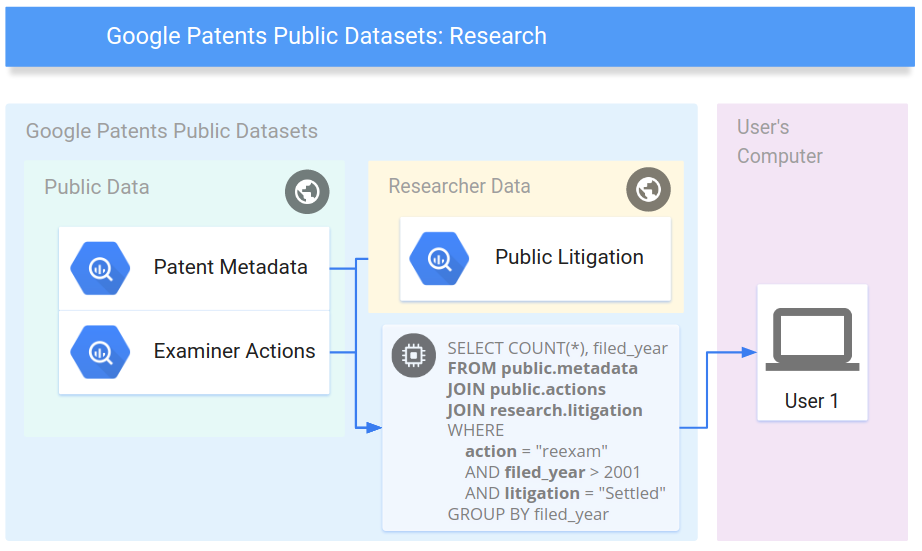
These datasets incorporates Google Patents Public Data table containing worldwide bibliographic information on more than 90 million patent publications from 17 countries and US full text, provided by IFI CLAIMS Patent Services. Along with this Google is also providing a Google Patents Research Data table containing English machine translations for all titles and abstracts from Google Translate, similarity vectors, extracted top terms, and more. Common research datasets from patents, chemistry, and litigation have also been uploaded. Users can get to data gathered by different analysts and patent information suppliers in a similar database, and blend them with private information to create reports or research queries with the full opportunity of SQL, without setting up their very own database.

1

Commercial Data providers are also making their patent data available for purchase in BigQuery, starting with IFI CLAIMS Patent Data Enrichments including legal status information and standardized assignee names. Accessing these datasets through BigQuery gives users an up-to-date database managed by data providers, so users get the flexibility of a database without the engineering cost of maintaining one. Getting to these datasets through BigQuery surrenders clients a to-date database oversaw by information suppliers, so clients get the adaptability of a database without the designing expense of looking after one.

2

Several third party tools such as Tableau and Looker that can access BigQuery can also be employed which provide much easier interface for accessing database than SQL. For corporate having classified data that cannot leave their network, some of these tools can be used to fetch from the BigQuery and process that in conjunction to sensitive data.

BigQuery for Data Providers

For data providers, BigQuery is an extraordinary approach to pitch information in a right away helpful configuration to clients. The commonplace choices for information dissemination are either in bulk format through CSV/XML downloads, or through a web interface, yet both have drawbacks. Bulk format permit adaptability to the detriment of the client programming and keeping up their own databases, while web interfaces are anything but difficult to get to, however can’t undoubtedly be reached out with new paid or private wellsprings of information, and have a settled arrangement of conceivable approaches to question and show the information. Presently clients can get a similar adaptability of a database with the simple access of a web interface to associate private information and show it in dashboards and other visualization tools.

Source : https://cloud.google.com/blog/big-data/2017/10/google-patents-public-datasets-connecting-public-paid-and-private-patent-data

WIPO का नया AI आधारित टूल : WIPO TRANSLATE

पेटेंट दस्तावेजों के लिए विश्व बौद्धिक संपदा संगठन (WIPO) का आर्टिफिशयल इंटेलिजेंस (एआई) आधारित अनुवाद उपकरण अब दस भाषाओं में उपलब्ध है। WIPO Translate एक तत्काल अनुवाद उपकरण है जो विशेष रूप से पेटेंट दस्तावेजों के लिए डिज़ाइन किया गया है, जिनका अनुवाद करना अत्यधिक चुनौतिपूर्ण होता है । WIPO का यह टूल ओपन सोर्स सॉफ़्टवेयर और लाइब्रेरी (Nematus – Theano, AmuNMT) पर आधारित है |

WIPO Translate एक अत्याधुनिक तंत्रिका मशीन अनुवाद (neural machine translation) तकनीक को समाहित करता है जो उच्च तकनीकी पेटेंट दस्तावेजों को उनकी वाक्य-रचना और शैली के आधार पर उनका दूसरी भाषा में अनुवाद करता है ,जो पिछली तकनीकों पर निर्मित अन्य अनुवाद उपकरण के लिए करना संभव नहीं हो पता था |

अंग्रेजी और चीनी में उपलब्ध टूल के पहले संस्करण को 2016 में लॉन्च किया गया था। WIPO ने अब पीसीटी (अरबी, जर्मन, स्पेनिश, फ्रेंच, कोरियाई) के अंतर्गत आने वाली आधिकारिक भाषा में सभी पेटेंट दस्तावेजों का अनुवाद करने के लिए नई तकनीक “प्रशिक्षित” की है जो PCT कि किसी भी भाषा को अंग्रेजी में और उसके विपरीत अनुवाद करने में सक्षम है |

WIPO Translate Patentscope डाटाबेस के माध्यम से नि: शुल्क उपलब्ध है, जो दुनिया भर के अंतरराष्ट्रीय पेटेंट आवेदन पत्र दाखिल करने से पहले आविष्कारकों द्वारा शोध के लिए उपयोग किया जाता है। यह डाटाबेस अंतरराष्ट्रीय पेटेंट सहयोग संधि (पीसीटी) को पेटेंट प्रकाशन के दिन पूरे पाठ प्रारूप में आवेदनों तक पहुंच प्रदान करता है, साथ ही भाग लेने वाले राष्ट्रीय और क्षेत्रीय पेटेंट कार्यालयों के पेटेंट दस्तावेजों की भी उपलब्धता प्रदान करता है । जानकारी को कई भाषाओं में खोजशब्दों, आवेदकों के नाम, अंतर्राष्ट्रीय पेटेंट वर्गीकरण और कई अन्य खोज मापदंडों में दर्ज करके खोजा जा सकता है। डेटाबेस में करीब 65 मिलियन दस्तावेज हैं।

WIPO के निदेशक General Francis Gurry के अनुसार “पेटेंट सिस्टम का प्रमुख उद्देश्य लोगों तक प्रौद्योगिकी उपलब्ध कराना है | उस उद्देश्य कि सार्वभौमिक उपलब्धि के लिए भाषा एक बाधा है | WIPO Translate के लिए सफलता का मतलब है कि पेटेंट दस्तावेजों कि विशाल, और निरंतर बढ़ती संख्या अन्वेषकों के लिए आसानी से सुलभ हो सके जो इन अभिलेखों को प्रेरणा या तकनीकी जानकारियों के लिए खोजते हैं | वैश्विक रुझान के एक हिस्से के रूप में, पूर्वी एशियाई भाषाओं में पेटेंट आवेदन तेजी से दायर किए जा रहे हैं, विशेषकर चीनी में, और WIPO Translate इस बात को सुनिश्चित करने में सहायता करता है कि इन भाषाओं में बनाए गए अत्याधुनिक ज्ञान को व्यापक रूप से और तेज़ी से संभवतः साझा किया जा सके । WIPO Translate को विस्तारित करने के लिए दुनिया भर के अन्वेषकों का स्वागत है । यह टूल मूल भाषाओं में दर्ज प्रौद्योगिकी ज्ञान के लिए पहुंच सुनिश्चित कराता है। “

Neural machine translation (तंत्रिका मशीन अनुवाद) एक उभरती हुई तकनीक है यह विशाल तंत्रिका नेटवर्क मॉडल पर आधारित है जो पहले अनुवादित वाक्यों से “सीखता” है । तंत्रिका मशीन अनुवाद की विशिष्टता (पिछले “वाक्यांश आधारित” सांख्यिकीय विधियों की तुलना में) यह है कि यह अधिक प्राकृतिक शब्द क्रम पैदा करता है, तथा इसका तथाकथित दूरस्त देशो के भाषओं के जोड़े, जैसे कि जापानी-अंग्रेज़ी या चीनी-अंग्रेजी के अनुवाद में विशेष सुधार दिखाई देता है ।

हाल ही के एक टेस्ट में, WIPO Translate के तंत्रिका-आधारित मशीन अनुवाद सेवा ने दूरस्थ भाषा के जोड़ों के साथ-साथ अन्य गैर-WIPO अनुवाद सेवाओं पर पिछले सांख्यिकीय-आधारित विधियों की तुलना में काफी बेहतर परिणाम दिया है । चूंकि इस उपकरण को पेटेंट दस्तावेजों पर विशिष्ट रूप से प्रशिक्षित और केंद्रित किया गया है, यह असमान शृंखला समूह विषय वाक्य (disparate array of texts) की बजाय उच्च-गुणवत्ता वाला अनुवाद देता है। यह टूल आंतरिक रूप से अंतर्राष्ट्रीय पेटेंट वर्गीकरण से ली गई 32 तकनीकी कार्यक्षेत्र (Domains) को एकीकृत करता है । इससे प्रणाली को अनुवाद प्रक्रिया में अस्पष्टता को खत्म करने में सफलता मिलती है। एक विशेष वाक्य का अनुवाद करते समय यह टूल प्रौद्योगिकी विशिष्ट कार्यक्षेत्र (Technical Domain) को ध्यान में रखता है, जिससे अधिक सटीक अनुवाद प्रदान किए जाते हैं ।

हमारा दृष्टिकोण – भारत में पेटेंट आवेदन के सन्दर्भ में :

पेटेंट तंत्र के प्रमुख लक्ष्यों में से एक लोगो तक सूचना उपलब्ध कराना है | यदि अन्वेषकों के हाथ में स्पष्ट और सुबोध जानकारी होगी जिसे वह समझ सकें तब ही वह नए आविष्कारों का पेटेंट दर्ज करा सकेंगे | यह तभी संभव हो सकता है जब पेटेंट को हिंदी में दर्ज कराने कि सुविधा हो एवं पहले से दर्ज पेटेंट भी हिंदी भाषा में उपलब्ध हो सकें | यह कार्य निश्चित ही बहुत बड़ा एवं चुनौतीपूर्ण है किन्तु यह देश के विकास के लिए एक महत्वपूर्ण कार्य है क्यूंकि आने वाले समय में बौद्धिक संपदा ही देश के विकास का मापदंड होगी | गौरतलब है कि भारत सरकार ने देर से ही सही इस आवश्यकता को समझा और अब भारत सरकार का ही एक उपक्रम CDAC ,WIPO जैसा ही ट्रांसलेशन टूल को बनाने का प्रयास कर रहा है | हम आशा करते हैं कि जल्द-से-जल्द यह टूल लोगों को उपलब्ध हो ताकि भाषा का रोड़ा विकास पथ के आड़े नहीं आ पाए |

How to Register IPR in India

According to the World Intellectual Property Organisation (WIPO), intellectual belongings refers to creations of thoughts: innovations; literary and creative works; and symbols, names and pictures used in commerce. It can be bifurcated into two categories :

1. Industrial assets which incorporates patents for innovations, commercial designs, logos, and geographical indications.

2. Copyrights which covers literary works (e.g. novels, poems and many others.), films, music and/or every other creative work.

As an inventor, proprietor or writer of such intellectual assets you have got rights, similar to in case of every other physical property. It prevents every person or entity to apply it without your permission in conjunction with giving due credit or even financial compensation.

To legally put in force such rights, you need to register your invention with the office of controller General of Patents, Designs & Trade Marks under Ministry of Commerce & Industry, Government of India.

File in your application as quickly as possible, as first-to-report rule is of great importance for registration of intellectual property. If two or more applications are identical or comparable only the the foremost application will be given importance for registration.

Patent implies a brand new product or procedure capable of industrial application. The product or procedure need to be a new invention that has not been used earlier than within the public domain. Time period for registered patents in India is 20 years.

Application for registration has to be filed inside the patents office of applicable territorial jurisdiction via the inventor either by self or through assigned legal representative. An important thing to understand is that those rights are territorial in nature and do no extend beyond the jurisdiction for which it is granted. If you want to reserve the IPR in different international boundries, then either you can file the patent application separately in countries of your preference or you can file Patent Cooperation Treaty (PCT) application simultaneously with application in Form-1.

In addition to Form 1 you need to fill Form 2 in which you need to mention the specification of your invention in detail and Form 3 and Form 5 in which you need to mention the details of any foreign filings for the same and a bonafide affirming that the product/process is your invention respectively.

Industrial Design

In accordance to WIPO, an industrial design refers to the ornamental or aesthetic aspects of an article. A design may comprise of 3-D features, such as the shape or surface of an article, or 2-D features such as patterns, lines or color. Industrial designs are applied to wide variety of industrial products containing distinctive features and handicraft items.

There is a separate Design Wing in the patent office under Government of India which oversees the registration process. The process is now online.You need to create an account,fill in the application, digitally sign the form (Form 5 and 44 ) and make the payment.

After the thorough examination, the copyright is granted, and the details of the same are entered into Register of Designs , maintained in the Patent Office. It contains parameters such as Name and address of the Proprieter , Design number, class number , date of filing, etc.

Any person can inspect the register after payment of prescribed fees.

Trademarks

A Trademark mark is a recognizable sign, design, or expression which identifies products or services belongs to or provided by certain individual or some legal entity.

A trademark identifies the brand owner of a particular product or service. Trademarks can also be licensed to others in order to earn revenue or brand proliferation. The unauthorized usage of trademarks by producing and trading counterfeit consumer goods is known as brand piracy. Regulation of Trademarks in India is governed under Trademarks Act, 1999. This Act is in compliance with World Trade Organization recommendations and Trade-Related Aspects of Intellectual Property Rights (TRIPS) Agreement.

You can obtain Trademark from Registrar of Trademark under the Office of Controller General of Patents, Designs & Trade Marks ,Government of India.The validity of Trademark is 10 years and you can again renew that for another 10 years.The Process of registration is now online.

To register follow the link ,create an account,fill in the application ,digitally sign the Form TM-1 and make the payment.

Like registration of Industrial Design, Trademark registration is also limited to certain territorial boundries. The Application is inspected for the uniqueness of the relevant mark ,whether is it enough to distinguish and differentiate an applicant’s good or service and whether it is prohibited for registration under any other law or is identical or similar to any existing marks. On successful grant ,the trademark is included in the Register of Trademark.

In case somebody wants to contest the grant of trademark, same should be intimated to the Office within 4 months from the date of publication in the official gazette.

Some important links:
(1)For e-Filling Patent,Design,GI etc.
(2)For Form and Fees.

Who claims the software, I simply paid to have developed? Who Owns What?

A typical copyright misinterpretation is that if a enterprise pays to have software built up, the software is a work made for hire and is naturally owned by an enterprise. In any case, that is not always true.

Hinging on this confusion can bring about a enterprise not owning software it paid to have developed.

The general rule is that the creator of a copyrightable work is naturally its proprietor. One essential exemption happens if software is created by an employee. In this case, the enterprise — and not the employee — will claim the copyright. Notwithstanding, if the work is developed by a contractor, proprietorship consequently vests in the hands of the same and not the enterprise that paid to have it developed.

logo

For what reason should a enterprise think about copyright possession? The copyright proprietor has boundless opportunity to market and change the work and to keep others from utilizing it. Truant ownership, leads to constrained rights to utilize the product by the enterprise, that was developed for it.

On the off chance if there is no drafted covenant, the copyright remains with the contractor, and the enterprise gets a nonexclusive license to utilize the product according to the understanding of the parties.

There are two critical words here. First, the enterprise entitlement to use the product is nonexclusive, which implies that the contractor can resell the software without paying anything to the enterprise.

Second, the product must be utilized by the enterprise in the way the parties concurred it would be used when the product was developed. For instance, if the product were developed for the interior utilization of the enterprise, pitching it to others would be outside of the extent of the license.

So what are a few things a enterprise ought to consider while hiring a software developer?

Intellectual Property Rights in the software by default belongs to the contractor. On the off chance if the IPR transfer agreement/development agreement do not mention the copyright proprietorship then the IPR belongs to contractor.

Jot down all things in an agreement. Copyrights must be exchanged by particular dialect in a document. Just a normal handshake deal or a verbal comprehension won’t transfer the copyright. Web based software development agreement should incorporate arrangements identified with possession.

Talk about possession right on time in the arrangement procedure. That may influence the cost of the task since the designer might plan to reuse all or part of that product in another venture.

Incorporate confidentiality provisions in the agreement. Custom developed software can contain privileged insights of an enterprise. Negotiate to keep those techniques secret and out of the hands of business competitors after the venture is done.

On the off chance that proprietorship can’t be negotiated, consider acquiring the privilege to utilize the product like a proprietor. Sometimes possession can’t be gotten on the grounds that the product incorporates routines that the contractor reuses in each task. Exchanging possession would mean the contractor would never again have the capacity to utilize those routines itself. Rather, consider consulting for the privilege to utilize and alter the product without constraint.

Ownership of the contractor developed software is crucial and often ignored aspect of the software development/innovator patent agreement. Being aware of the principles of copyright possession can spare the enterprise from numerous conceivable issues that may get apparent long after the product is delivered.

Also see : http://siddhast.com/innovators-patent-agreement

Written By : Arpit Agarwal

One-Click Purchase is no more a monopoly in World

Amazon looses its exclusive hold on one of the most contentious patents of the internet age. A simple non-obvious invention which even a novice programmer  can reproduce, that paybacks a company a hefty amount of money is no more the golden egg laying hen for the ecommerce company. Of course the idea is not big indeed, but to be a first in applying patent sets amazon rule the ecommerce market. Thanks to the Indian Patent Act, Section 3, 1970 ,which denies the grant of patent on mathematical or business method or a computer programe per se or algorithms. A victory won by expedient paperwork and not by a really appreciable groundbreaking work is now giving the company’s rival a breath of freedom.

In interview with Mr. Roshan , COO of Siddhast IP Innovation “The companies now have to focus on giving customer , a satisfactory services rather than winning its competitors by such stupid and scrupulous means of just protecting a simple button.” exclaimed IPR expert.